




Next-generation RNA Modification Profiling Services, Tailored to Your Research
From discovery to validation, EpiPlex™ delivers custom RNA profiling to support your scientific needs.
Why EpiPlex Services
Built for real-world samples
An end-to-end, turnkey solution
Tailored to your research
One platform, one workflow
Why m6A, inosine, and pseudouridine?
RNA modifications represent distinct regulatory dimensions of gene expression. Each answers different biological questions and is most informative in different disease and sample contexts.
m6A
N6-methyladenosine regulates RNA stability and translation in response to signaling, stress, and cell-state transitions. Profiling m6A is especially relevant when dynamic control of RNA fate is in play—for example in cancer, immune activation, and cell state or differentiation studies.
Inosine (A-to-I)
Adenosine-to-inosine editing introduces post-transcriptional sequence diversity that affects coding potential, RNA structure, and innate immune sensing. Inosine profiling is valuable when transcriptome plasticity or immune modulation matters, including cancer immune evasion, autoimmunity, and neurodegeneration.
Pseudouridine (Ψ)
Pseudouridine stabilizes RNA structure and supports translational fidelity under stress. It is particularly relevant in contexts where sustained translation or RNA stability is critical—such as neurodegeneration, cardiovascular and metabolic disease, and aging.
Flexible services for every study
EpiPlex Services differ in the type of biological insight they deliver. Select the configuration that aligns with your hypothesis and sample context.

Uni-Mod
One of: m6A, inosine, or pseudouridine
Pick one modification to get started in epitranscriptomics.
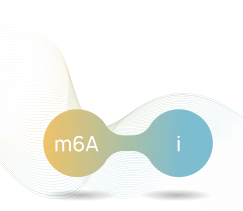
Duo-Mod
m6A + inosine
Measure m6A and inosine together for a first look at correlative changes.
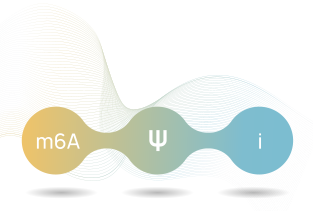
Tri-Mod
m6A + inosine + pseudouridine
Choose all three of the most abundant mods—m6A, I, and Ψ—to unlock the epitranscriptome.
Samples
1-47
48+
72+
96+
See EpiPlex technology in action
A shared experimental and analytical foundation underlies every service: enrichment-based workflows, spike-in normalization, and EpiScout™ analysis, enabling consistent, interpretable results across sample types and service configurations.
Platform differentiators
- Common platform and workflow across all service configurations
- Relative quantification with spike-in normalization for confident interpretation
- End-to-end service from sample receipt to EpiScout™ results
- Applications science support across discovery and translational research
Ready to get started?
Request a quote for your project. Our team will help you select the configuration that best fits your biological question, sample context, and interpretive goals.
Prefer to run the assay yourself?
EpiPlex™ RNA Mod Encoding Kit, UDI Kit, and EpiScout™ analysis software are available for in-lab use. Same platform, same quality.